
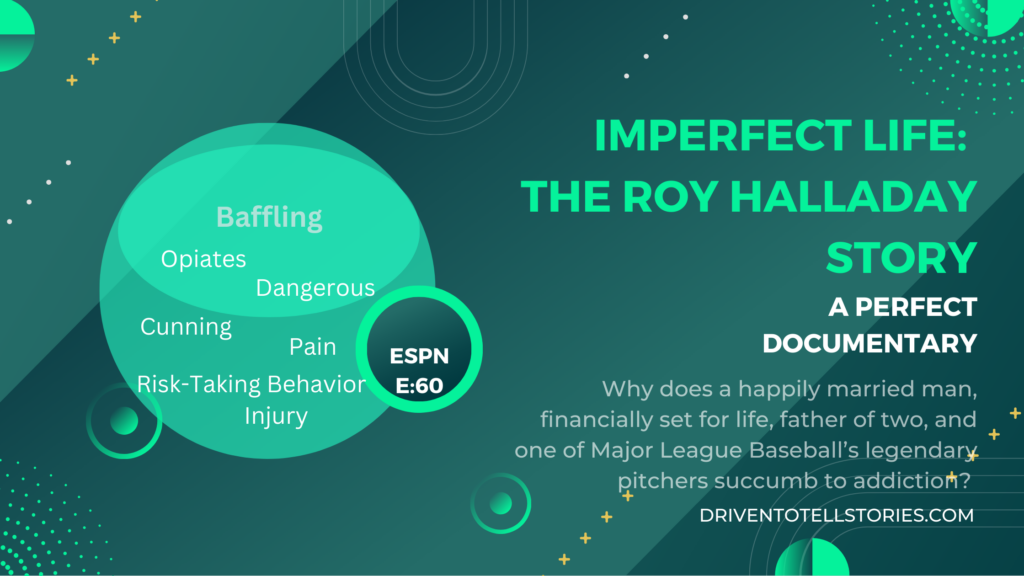
Gripping. Eye-opening. Tragic. ESPN’s E:60 Imperfect: The Roy Halladay Story tells the story of the enigma that is addiction.
Why does a happily married man, financially set for life, father of two, and one of Major League Baseball’s legendary pitchers succumb to addiction?
Ever wondered why addiction is described as cunning, baffling, and dangerous? Watch this documentary.
Storytelling strategies that worked
The director let the characters, those interviewed, reveal the story. Everyone interviewed was forthright and knew Halladay well, including his wife, his older son, his father, and former teammates.
Excerpted footage of Halladay at various stages of his life, including childhood, were effectively used and let the viewer get to know the often conflicting public and private sides of Halladay. Quoting co-producer Mike Farrell from ESPN Front Row’s Journalism Showcase: Production Notes from E60’s ‘Imperfect: The Roy Halladay Story’, “Home video and personal photos are always the best way to convey to the viewer what that person was like. Especially given the focus of our story, when there is so much archival baseball footage of Roy, it was paramount for us to secure everyday family photos to provide a more balanced portrait of who he was.”
I can’t get one clip out of my mind—a brief interview during the time Halladay began taking opiates in order to be able to pitch through the excruciating pain from his severe back injury. Halladay, standing next to the field and wearing his baseball uniform, spoke coherently, but in a somewhat strained voice. However, his eyes were incredibly glassy. It was as if Vaseline had been smeared all over them.
High Anxiety
ESPN.com site features a trailer for ESPN’s E:60 Imperfect: The Roy Halladay Story and an accompanying profile of Halladay, “While Halladay projected confidence to the world, he privately struggled in a way known only to those in his tight inner circle.”
Before the acute pain from injury that led to his use of opiates came the mental pain of severe anxiety dating back to his early days as a pitcher. Halladay was drafted out of high school. His wife recounted that in the early day of their marriage, he would lock himself in a room to “unwind” with alcohol.
Clinical anxiety is unto its own and barely resembles fleeting, everyday anxiety. Symptoms include restlessness, a sense of impending doom, feeling constantly “on edge,” inability to concentrate, and irritability. It is so painful that the brain can trick the soul into thinking that whatever means necessary justify easing it.
Power of Opiates
“No analogy can really do justice to the idiotic bliss, the transcendent euphoria, the staggering ecstasy of the serious opioid high,” describes Timothy O’Neill in “My Decade-Long Love Affair With Opioids” on Medium.com. Aside from casting a spell on its users, withdrawal is vicious and often needs to be medically supervised.
Because of the rigor placed on the body and the pressures of competition, there is a connection between athletes and opioids, which is discussed in these brief articles on BroadBeachRecoveryCenter.com’s site, The Opioid-Athlete Connection and Opioid Abuse by Retired Players.
According to the CDC’s website, “more than 67,000 people died from drug overdoses in 2018, making it a leading cause of injury-related death in the United States. Of those deaths, almost 70% involved a prescription or illicit opioid.”
Substances distort character
Halladay’s fatal plane crash could never have happened if he had honestly answered the FAA drug screening questionnaire. If he had listed the prescriptions he was taking, he would not have been allowed to fly. Why did Halladay lie to the FAA and claim he was not taking any prescription medication?
Addicts think they are in control of their drug intake and that they can manage it. That it fixes them. Makes them ok. That others couldn’t possibly understand, so why bother to explain?
The drugs distort brain function/judgment, which in turn distorts character. Stretches it. At times, even obliterates it. One of the reasons this documentary is so remarkable is that it shows the addict’s expert deception and the power addiction can command over a highly functional, highly engaged human being.
It doesn’t appear that Halladay experienced trauma or abuse growing up or as an adult, but it is impossible to know the exact nature of his innate temperament and what it’s like to experience severe anxiety, significant ADD or ADHD, and the highest level of physical pain.
Inadequate follow-up treatment
Halladay went through rehab while he was still a professional baseball player, but left after three weeks and did not complete treatment. The second time he attended rehab was after he retired from baseball, and he did complete treatment.
Given Halladay’s long history with anxiety, depression, and substances, including excessive drinking since his early 20s, compulsive eating after retiring from baseball, and extensive use of opiates, I think he would have benefitted from a much stricter transition plan after being released from rehab.
I can only imagine the rush from playing a sport that an athlete who has made it to the professional level must experience. To go from the regimen, rigor, and intense physical activity of professional sports to civilian life with no true focus outside of family other than coaching a high school baseball team does not seem like a good plan.
Quoting USA Today columnist Bob Nightengale’s May 28, 2020 piece about the ESPN documentary, “He didn’t know how to self-evaluate without baseball,’’ Brandy Halladay said. “He didn’t know who he was. If baseball was his identify, then what was he?”
Halladay had Adderall in his system. Perhaps he had ADD or ADHD, which poses many of its own challenges and can develop into mental anguish if not accommodated properly.
In addition to visits with a psychiatrist and marriage counselor, Halladay could have benefitted from a sober coach, group therapy with fellow addicts led by an addiction specialist, and meeting with support groups for addicts in recovery. Sober coaches can help get the recovering addict to meetings and also help recovering addicts develop healthy routines.
Why go public?
Roy Halladay’s widow, Brandy, gave this touching speech in November, 2017 shortly after her husband died, … “He was beautiful inside and out.”
“If one person asks for help that was scared to before, then we did a good thing,’’ Brandy Halladay answered when asked why go public with Halladay’s battle with addiction and mental health challenges.